Jess Grindlay, NISTA's Lead Data Scientist, talks about her experiences hacking creative solutions to help manage government projects
In NISTA, we often say ‘Projects don’t go wrong, they start wrong’.
As the home of government project data, the NISTA Data & Insight team supports major projects once they’re up and running. We collect and analyse delivery data and build tools to help projects stay on track, including:
- advanced cloud-based data reporting dashboards
- a machine learning Early Warning System to indicate poor project performance
- an AI tool to support assurance reviews (Scout)
- AI tools to find thematic issues in large amounts of text data.
A key part of NISTA’s role is setting standards and providing expert guidance to support project delivery teams managing individual projects, and improving government’s overall project delivery capabilities.
In the data team, we’ve been thinking a lot about what additional products could help set projects on the right path before any delivery data even exists.
This is the problem we wanted to solve at the Government Digital Service AI Engineering Hackathon, on Thursday 16 April.
Hosted by Version 1 at CodeNode, the hackathon brought together 40 teams comprising of 200 data scientists and engineers from across government. Throughout the day we met other brilliant Government Data Science teams – working on everything from tools for farmers to navigate government regulation to AI-driven casework prioritisation.
With access to forward‑deployed engineers, lightning talks from Microsoft, Anthropic and GitHub, and a powerful suite of AI tools (including AWS Kiro with in‑line AI agents), we were able to rapidly create a prototype of a full‑stack solution – essentially, a solution integrating the user interface, backend workflow and structured database in a single app – within a single day.
That solution was Cub: an AI‑powered project set‑up tool to support delivery teams get a project up and running.
In short, Cub takes a Project Initiation Document (PID) and early scoping material for the project and turns it into a fully formed project plan: an interactive Kanban board (a visual tool that maps workflows), resource and cost tracking, and a live risk register. It’s underpinned by the Teal Book, helping teams set up projects in line with government best practice from day one.
We also built in:
- a chatbot and document viewer to interrogate the PID and generated plan
- advanced analytics, including supplier intelligence and sentiment analysis drawn from news on similar live projects in delivery.
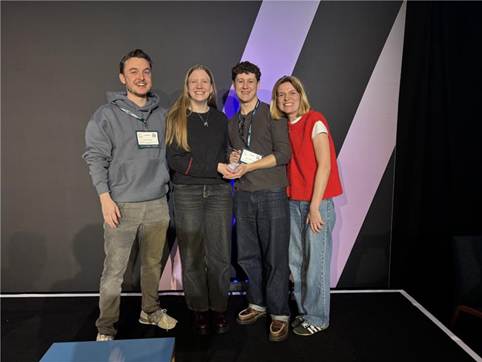
As the day continued, the pressure ramped up with a live-updating leaderboard scoring the teams in real-time, to select the three that would demonstrate their solutions. We were selected to present our prototype on stage... and ended up winning the Hackathon!
Judges scored teams on innovation, collaboration, use of AI, testing, handling edge cases and plans for future development, and Cub stood out across them all!
Huge thanks to GDS for organising such a high‑energy, inspiring event.
We can’t wait to see in the future how Cub helps NISTA and the wider Project Delivery Function set projects on the right path from the very start.
Leave a comment